
Honeycombing Repair to Transfer Slab
Slabtec was engaged to remediate significant honeycombing identified in a transfer slab.
Honeycombing can occur for several reasons, including congested reinforcement, insufficient vibration during concrete placement, or low-slump concrete that does not adequately flow into restricted areas. If left untreated, honeycombing can affect both the structural performance and long-term durability of the slab.
In addition to the honeycombing, areas of low reinforcement cover were identified, which needed to be addressed as part of the repair solution to ensure the long-term durability of the structure.
Investigation and Defect Assessment
Slabtec conducted Ground Penetrating Radar (GPR) scanning to determine the extent of the honeycombing and accurately locate reinforcement. This allowed the repair works to be carefully planned and ensured that only the defective concrete was removed.
Concrete Removal Using Hydro Demolition
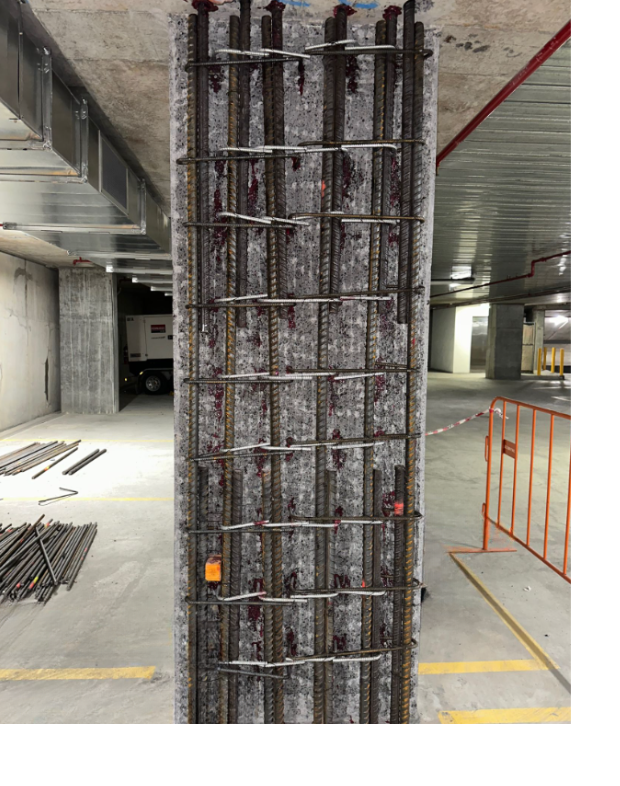
Hydro demolition was then used to remove the damaged concrete. This method allows for very precise removal of defective concrete while leaving reinforcement and surrounding sound concrete intact, making it particularly suitable for structural repair works.
Repair Methodology and Durability Upgrade
Once the defective concrete had been removed, the exposed reinforcement was treated with a corrosion inhibitor to reduce the risk of future corrosion and spalling. Formwork was then constructed to incorporate a 30mm step, addressing the low reinforcement cover and improving the slab’s durability.
To complete the repair, holes were drilled from the top of the slab to allow a low-viscosity, high-compressive-strength concrete mortar to be poured into the repair zone. This ensured full encapsulation of the reinforcement and complete filling of all voids within the repair area.
Project Outcome
The result was a large, complex repair completed to a high standard, restoring the transfer slab’s structural integrity, addressing durability concerns, and extending the structure’s service life. The client was very pleased with the outcome and the professional finish of the completed works.