
Structural strengthening – understanding the options
When a structure shows deterioration, damage or insufficient capacity, should it be repaired, strengthened or replaced?
The decision has significant implications for cost, disruption and the future use of the asset.
Where the existing structure can be retained, strengthening can offer substantial cost savings compared with demolition and replacement, while reducing construction time and operational interruption.
Understanding what each approach achieves is the starting point:
- Repair addresses damage or deterioration.
- Strengthening increases structural capacity or improves performance.
- Replacement removes and reconstructs affected elements or the entire structure.
The appropriate solution may involve one approach or a combination.
Understand the problem first
Cracking, spalling concrete, corrosion, staining, or deflection may indicate a problem, but they do not necessarily reveal its cause or extent.
Equally, a structure in sound condition may need additional capacity to accommodate increased loads or a change in use.
Investigation and structural assessment should establish the cause and extent of any deterioration, the existing capacity and the performance required over the asset’s intended remaining life.
Access, construction constraints and the need to maintain operations also influence which options are practical. This assessment helps avoid treating visible symptoms while leaving the underlying problem unresolved.
When is repair appropriate?
Repair focuses on restoring the condition, integrity or protective function of an existing element. It may be appropriate for cracked or spalling concrete, reinforcement corrosion, water ingress, localised damage or construction defects.
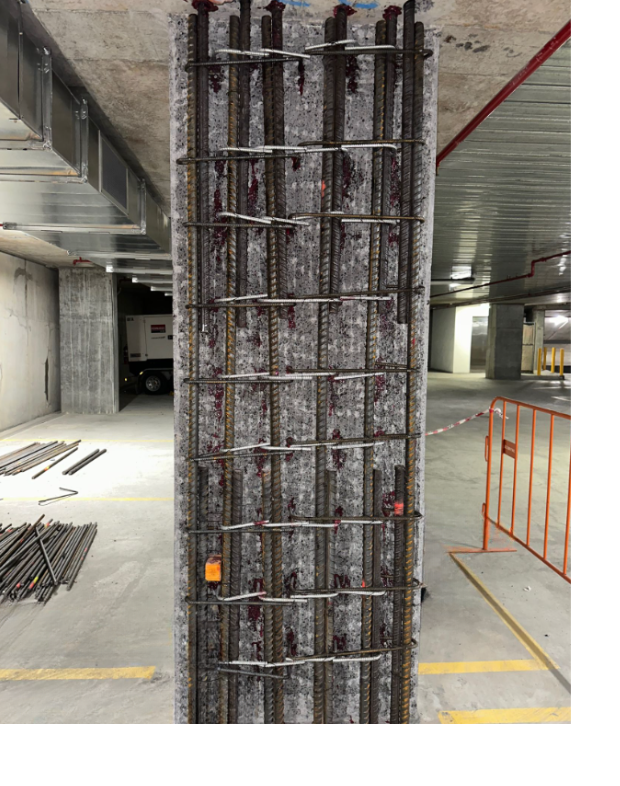
Work can include removing unsound concrete, treating or replacing corroded reinforcement, reinstating the concrete profile, injecting cracks and applying protective systems.
Repair can restore damaged material and help prevent further deterioration. However, it does not automatically increase the element’s original load-carrying capacity. If additional capacity is required, strengthening may also be necessary.
When is strengthening required?
Strengthening addresses a shortfall in structural capacity or performance. It may be needed because of:
- Increased floor or traffic loads
- A change in building use or new plant and equipment
- New openings or changes to the structural layout
- Design or construction deficiencies
- Deterioration that has reduced capacity
- Revised loading or performance requirements.
Methods include carbon fibre reinforced polymer (CFRP), steel plates or sections, additional reinforced concrete and post-tensioning.
CFRP is particularly useful where additional capacity is required with minimal added weight or change to the element’s dimensions. Depending on the design, laminates or carbon-fibre fabric can provide flexural, shear or confinement strengthening.
Why consider strengthening before replacement?
Cost is a major reason to assess strengthening before committing to replacement. Retaining and upgrading an existing structure can avoid substantial expenditure on demolition, removal and reconstruction.
The financial benefit can extend beyond the construction works. Shorter programs and reduced closures may also limit disruption to tenants, businesses, traffic or asset operations.
Where technically suitable, strengthening can offer:
- Substantial savings compared with replacement
- Shorter construction programs and reduced operational disruption
- Targeted intervention with less impact on surrounding finishes and services
- Less demolition waste and reduced demand for new construction materials.
These benefits make strengthening an option worth investigating early. The achievable savings depend on the structure’s condition, the required upgrade, access and the scope of associated repairs.


When are repair and strengthening combined?
Repair and strengthening frequently work together.
A concrete beam affected by reinforcement corrosion may first require removal of unsound material, treatment of the reinforcement and reinstatement of the concrete profile. If capacity has been lost, or increased loads are proposed, the beam may then require strengthening.
Repair establishes a suitable substrate and addresses deterioration; strengthening provides the required capacity.
Externally bonded CFRP requires sound, properly prepared concrete. Applying it over weak, contaminated or unsound material will not resolve the underlying problem.
When is replacement the better option?
Replacement may be appropriate where repair and strengthening cannot deliver a practical, reliable or economical outcome.
Reasons can include severe or widespread deterioration, major deformation, fundamental structural or foundation limitations, or changes in layout and use that the existing structure cannot reasonably accommodate.
The cost and expected life of the proposed intervention also matter. Retaining a structure offers limited value if extensive work would deliver only a short period of useful service or require repeated intervention.
Replacement does not always mean demolishing the entire asset. An affected element or section may be reconstructed while the remainder is retained.
Compare the full project cost and long-term value
A meaningful comparison should consider more than the price of the strengthening system or replacement element. It should account for:
- Total project cost: associated repairs, demolition, temporary works, access and reinstatement.
- Operational impacts: closures, loss of access, traffic management, and business interruption.
- Required performance: capacity, future use and intended remaining service life.
- Durability: exposure conditions, protection requirements and future maintenance.
Strengthening can deliver a strong financial advantage where the existing structure remains suitable for retention. Engineering assessment establishes whether it can also meet the required structural and service-life objectives.
How Slabtec can help
Slabtec works with structural engineers, asset owners and project teams to deliver concrete repair and structural-strengthening solutions for existing buildings and infrastructure.
Our experience in CFRP installation and complex remediation enables us to plan works around structural requirements, site constraints and operational needs.
Considering replacement?
Speak with Slabtec about whether repair and strengthening could provide a more cost-effective way forward.